Gum treatment and dental cleaning in Murcia
Gums and sensitivity
We put our professional experience at your service so you can recover the health of your gums and the tissues that support your teeth. We teach you how to look after them so you keep everything you gain at the clinic. We care for you.
Dr. Nanut Dell'Amico & team of specialists
- Swiss EMS Air-Flow® technology
- Tooth sensitivity
- Teaching good habits

The most common question
Why are my gums bleeding?
Healthy gums do not bleed. If they bleed when you brush, it is a sign they are inflamed.
The most common cause is a build-up of tartar around the teeth, which infects and inflames the gum (gingivitis). Treated in time, it can be solved. If left untreated, it can progress to periodontitis, in which the bone that holds the teeth is lost and the gum recedes.
Warning signs
When should I have my gums checked?
- 01They bleed when you brush, or for no reason
- 02They are red or swollen
- 03Your teeth look longer
- 04You notice sensitivity to hot or cold
- 05Food gets stuck between your teeth
- 06You notice a loose tooth
Gum disease usually progresses without pain for years. Do not wait until it hurts: the sooner we stop it, the better.
Healthy gums and tissues
Get to know your gums
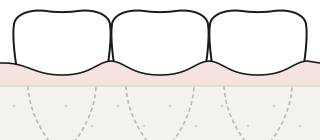
Healthy gums
In general, healthy gums are pale pink and do not bleed. The papilla, the triangular piece of gum between the teeth, has a sharp, well-defined "knife-edge" tip and leaves no empty spaces between the teeth.
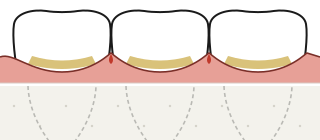
Gingivitis
Inflammation of the gum, mostly caused by a build-up of deposits (soft or hard tartar) around the teeth. It can be recognised by a dark "wine-red" colour and swelling that rounds off the tip of the papilla. The gum may bleed when touched or spontaneously.
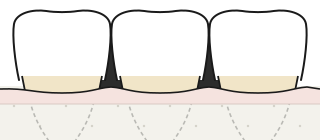
Receding gums
This happens when the bone that supports the gum is lost. The most common cause is poor oral hygiene over a long period, together with each person's individual risk factors. It is a slow, chronic process, which is why it is so important to stop it in time.
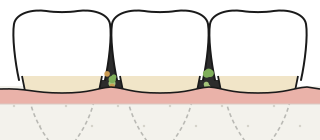
Food trapping
When the papilla between the teeth disappears, empty spaces are left. Food gets trapped in them, causing recurring infection and making the problem even worse.
Tooth sensitivity
Why are my teeth sensitive?
Sensitivity appears when cold passes through the microscopic pores of the tooth and reaches the nerve.
Your own saliva is a natural desensitiser, because it contains calcium. But acidic foods and drinks, such as oranges, mandarins, grapefruit, lemon, cola drinks or vinegar, open those pores and make sensitivity appear or get worse.
How we get rid of it
- Watch your diet: cut down on acidic foods and drinks.
- Rinse with water after eating any citrus fruit. This also helps prevent decay, which is a loss of calcium from the tooth caused by the acids in citrus fruit or by the bacteria that ferment sugary foods.
- Varnishes at the clinic: we apply very effective varnishes that seal the sensitive area against cold.
- To stop it coming back: once it has gone, you only need to control the diet that causes it.
Treatment
Cleaning and healthy gums
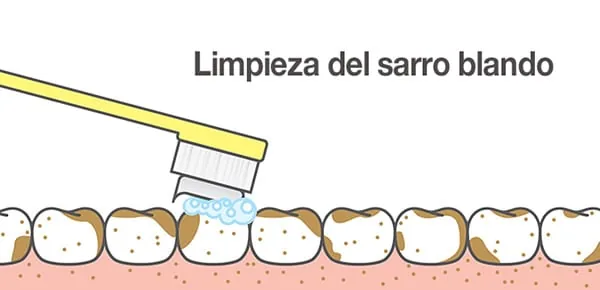
Dental cleaning
We remove soft tartar or bacterial plaque, the deposits that damage the gums, with rotary instruments and prophylaxis pastes that disinfect and polish. For the most stubborn stains we use high-pressure disinfecting powder with EMS Air-Flow®, the Swiss benchmark technology in dental cleaning.
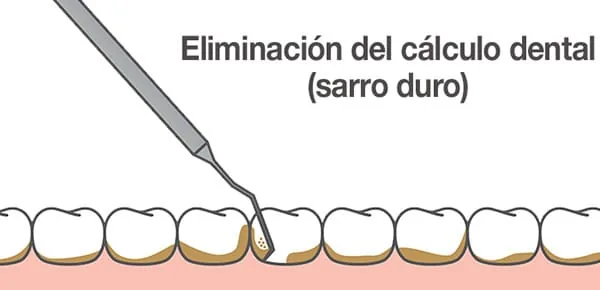
Tartar removal
Calculus is hard tartar: once it has formed, brushing can no longer remove it. We remove it with ultrasound technology. It is very important to remove 100% of the calculus, because leaving any behind allows it to grow back.
Why a cleaning every year?
Nobody brushes perfectly
Even people who brush well leave small traces of tartar every day.
The calcium in saliva settles on those traces and hardens them into calculus, which the toothbrush can no longer remove. That is why we recommend a cleaning at least once a year to all our patients: it removes the calculus before it damages your gums and the bone that holds your teeth.
A cleaning once a year is a must: nobody brushes perfectly.
Step by step
What is the treatment like?
- 01
Diagnosis
We examine your gums, their colour and their condition, and measure their health with a periodontal chart.
- 02
Deep cleaning
We remove the plaque and 100% of the calculus, with ultrasound and EMS Air-Flow®.
- 03
We teach you to look after yourself
From your first visit you learn the hygiene technique you need.
- 04
Free check-ups
We stay with you, reinforcing what you have learned so the results last.
Our philosophy
We teach you to look after yourself!
Our philosophy is to solve your problems and stay by your side, teaching you the hygiene techniques that will help you keep the results for the long term.
We start at your very first visit. And we will always be there for you with free check-ups and reminders of what you have learned. Our greatest professional satisfaction is knowing you have learned to look after your teeth.
Bleeding gums? Do not wait until it hurts
Frequently asked questions
Your questions, answered
If you have any other question, message us on WhatsApp and we will reply.
Is it normal for my gums to bleed when I brush?
No. Healthy gums do not bleed. Bleeding when you brush is usually the first sign of gingivitis, the inflammation of the gum caused by a build-up of tartar. Treated in time, it can be solved; left untreated, it can turn into periodontitis with receding gums.
Can receding gums be fixed?
It depends on the case. In most cases gum recession is irreversible, and in others it can be corrected with periodontal surgery. That is why the most important thing is to stop it in time, before pain appears and it gets worse.
Why are my teeth sensitive?
Because cold passes through the microscopic pores of the tooth and reaches the nerve. Acidic foods and drinks, such as citrus fruit, cola drinks or vinegar, open those pores and increase sensitivity. That is why treatment starts with your diet and is completed with varnishes that seal the sensitive area.
How often should I have a dental cleaning?
At least once a year, even if you brush well: nobody brushes perfectly. Small traces of tartar always remain, and the calcium in saliva hardens them into calculus, which the toothbrush can no longer remove. A yearly cleaning removes it before it damages your gums.
Does a dental cleaning damage the enamel?
No. Cleaning removes tartar and plaque, not enamel. On the contrary: it leaves the surface of your teeth clean, shiny and healthy.
Why does food get stuck between my teeth?
It is usually a consequence of receding gums: when the papilla between the teeth disappears, spaces are left where food gets trapped. It can also be caused by misaligned teeth, overhanging fillings, and crowns or veneers that do not follow the correct anatomy of the tooth. Treatment consists of correcting the cause.
How much does the treatment cost?
It depends on what you need. After the diagnosis we give you a detailed quote, and you can spread the cost over up to 60 months, interest-free. Follow-up check-ups are free.
Why choose us
Gum treatment in Murcia, since 1989
01
Swiss technology
EMS Air-Flow®: maximum effectiveness for removing tartar completely.
02
All conditions
We treat all gum problems, acute or chronic.
03
We teach you
Learning the right hygiene technique is the guarantee of long-term success.
04
Free check-ups
We will always be with you, reinforcing what you have learned.
Keep exploring